Home → Timeline → this article
Rangers Find Missing Hunter After Search of Five Hours
Daily Colonist14 November 1948p. 3Before 1979
“Rangers Find Missing Hunter After Search of Five Hours”, Daily Colonist, p. 3, 14 November 1948 ref-only
Summary
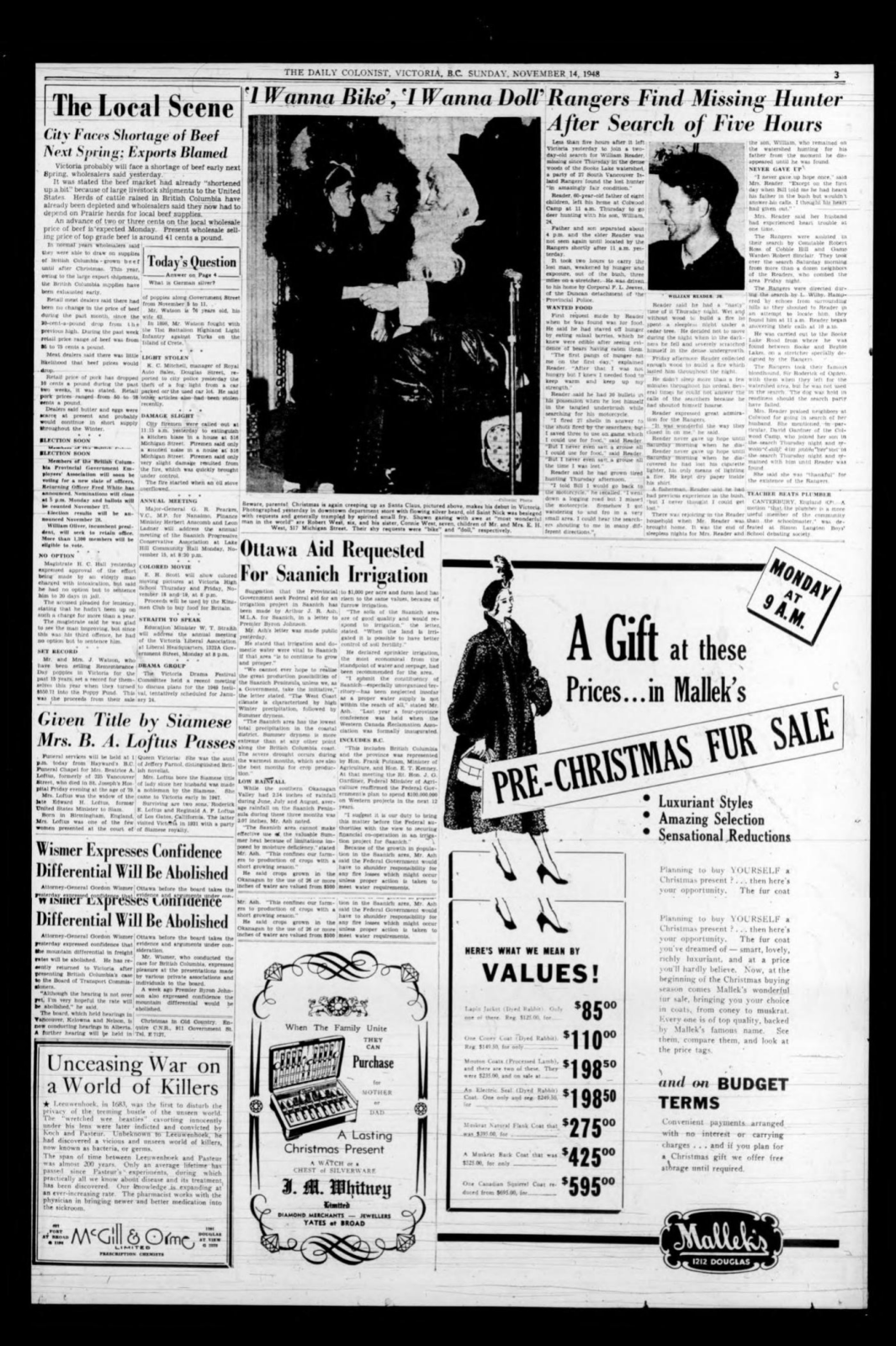
A party of 27 South Vancouver Island Rangers found William Reader, a 60-year-old father of eight from Colwood Camp, in the dense woods of the Sooke Lake watershed, less than five hours after the party left Victoria to join a search that was already two days old. Reader had left home at 11 a.m. on Thursday to go deer hunting with his 24-year-old son William, became separated from him about 4 p.m., and was not seen again until the Rangers located him shortly after 11 a.m. on the Saturday, "in amazingly fair condition." It took two hours to carry him three miles out of the bush on a stretcher; he was weakened by hunger and exposure and was driven home by Corporal F. L. Jeeves of the Duncan detachment of the Provincial Police. Reader said he had staved off hunger by eating salal berries and had fired 27 of his 30 shells in answer to searchers' shots, and told the paper "It was wonderful the way they closed in on me."
Details
| Headline | “Rangers Find Missing Hunter After Search of Five Hours” |
|---|---|
| Publication | Daily Colonist |
| Date | 14 November 1948 |
| Page | 3 |
| Era | Before 1979 |
| Document type | news report |
| Source | britishcolonist.ca (University of Victoria) |
| Accessed | 2026-07-17 |
| Licensing | ref-only |
| Record confidence | confirmed |
Archivist's note
This is the earliest documented organized search in the archive and it predates every predecessor of JDF SAR: the searchers are the South Vancouver Island Rangers, not a Sooke organization. 07_context/2026-07-17_south_vancouver_island_rangers.md records the SVIR as incorporated in 1947 and describes it as the first incorporated search and rescue society in British Columbia; that claim is unverified. The Rangers appear again in the 1955-12-06 Daily Colonist search on this archive's shelf, which suggests they were the standing regional capability before any Sooke team existed.
The clipping